"The Fantastic Shophouse" - premiere of the Ballet Company
News публикувана на: 27.02.2018
 Go back
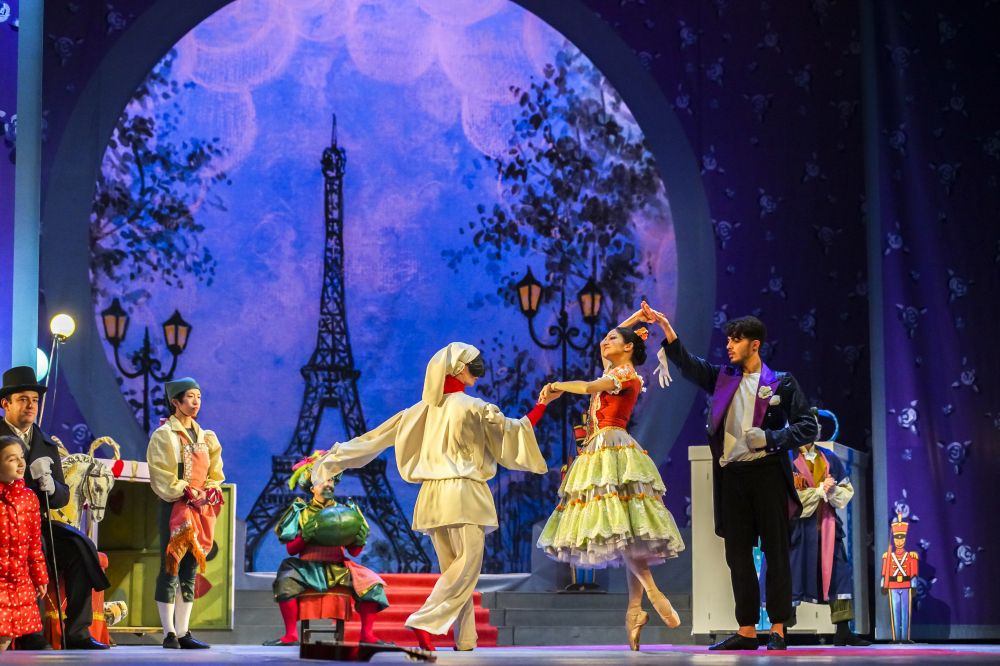
"La boutique fantasque" /
ballet by Gioachino Rossini / Ottorino Respighi
The ballet season of the State Opera Stara Zagora is dedicated to
90 years of Bulgarian professional ballet
On 28 February at 19.00 the premiere of the ballet "The Fantastic Boutique" to music by Gioachino Rossini / Ottorino Respighi will take place on the stage of the State Opera-Stara Zagora. The choreography is by the Italian prima ballerina, choreographer and teacher Alba Buonandi, and the set and costume design by the world-renowned Italian artist Salvatore Russo. Assistant choreographer Sylvia Tomova. In the performance take part: the entire ballet troupe of the State Opera-Stara Zagora, children from the Children's and Youth Opera and Ballet Studio "Margaritki", representatives of the choir of the State Opera-Stara Zagora and the Pre-Bulgarian Survival School "Baga-Tour".
History of the creation
"La boutique fantasque is a one-act ballet choreographed by Leonid Myasin to a libretto by André Derain, one of the pioneers of Fauvism in art. Derain also created the sets and costumes for the ballet's premiere. Ottorino Respighi wrote the music on piano pieces by Gioachino Rossini.
The world premiere of the work took place at London's Alhambra Theatre on 5 June 1919. The performers were the ballet dancers of Sergei Diaghilev's troupe, the so-called Russian Ballet.
Myasin tells how in Rome, for the ballet season, Respighi brought the score of The Sins of Old Age - a collection of 150 songs by Rossini - and gave it to Diaghilev. The impresario played it for Messines and Respighi. The painter Toulouse Lautrec contributed greatly to the style and scenery of The Fantastic Boutique, and Myasin described the character of the protagonist as "like Lautrec". Diaghilev arranged a meeting between Myasin and Derain in Paris, and the two began work on the libretto of the work, which was to be performed at the puppet theatre of the Rue Bonaparte. The time of the action was transferred from 1832 to 1860.
According to ballet historian Cyril Beaumont, the first performance was before an audience consisting of famous artists, painters and connoisseurs who were eagerly awaiting the new ballet. Picasso himself made a sketch of Myasin and Lopukova /in the leading roles/, in their final pose. Paris "sees" La boutique fantasque on Christmas Eve in 1919 by the ballet company of the genial entrepreneur Sergei Diaghilev. Despite Myasin's departure from the Ballets Russes in early January 1921, the ballet was staged at the Prince's Theatre in London in May and at the Gaite-Lyrique in Paris in 1925, and toured Europe in the following years. The last performance of Diaghilev's company was at the Vichy on 4 August 1929; two weeks later the great impresario died in Venice.
The history of the ballet is said by some to resemble Josef Bayer's The Doll Fairy, an old German ballet performed in 1897 in Moscow by José Mendes and in 1903 in St Petersburg by Serge and Nicolas Legga. Others find a resemblance to Hans Christian Andersen's tale The Brave Lead Soldier. Myasin's libretto centers on a love story between two puppets dancing the Can-can in a toy shop, combining elements of comedy, national folk dance, and pantomime on the one hand, and classical choreography on the other.
Contents
The action takes place in France in the 1860s.
A famous toymaker creates beautiful dancing dolls for his magic shop to dance in front of the shop's customers. At first, the toys entertain two English ladies and an American family. Some of the dolls play tarantella for the guests, followed by other dolls dressed as playing cards, who in turn dance the mazurka. Then other puppets enter and dance as well, and new customers arrive - a Russian family. Especially for them, Cossack puppets come in and perform a traditional dance, followed by a dance of animal puppets, a poodle dance.
Shortly thereafter, the store keeper introduces the most special and elaborate toy dolls that dance the kan-kan, a glamorously dressed boy and girl.Their dance is so charming that the American family decides to buy the male doll, and the Russian family buys the female dancing doll. The deal is done, the money is paid, and the dolls are placed in separate boxes. The collection of dolls is arranged for the next day.
The evening arrives. During the night, the magic dolls come to life and start dancing again.They are worried that the two dancing kan-kan dolls, who are in love with each other, will be separated. They conspire to hide the dolls before the seller comes in the morning.
When the store opens the next day and customers come in to pick up their dolls, they find that the kan-kan dancers are gone. Unaware of the secret life of the magic dolls, they blame the shop owner and his assistant for their absence. In the ensuing commotion, the dancer puppets come to the aid of the store keeper, and together with the Cossack puppets, attack the customers with their bayonets. Forced out of the shop, the customers watch bewilderedly through the window as the happy dolls and the shopkeeper dance merrily inside, along with the reunited pair of kan-kan dancer dolls.
Music
Respighi paints his musical images with an over-imaginative touch on several piano pieces by the genius prankster Rossini. Here the orchestra's handwriting changes according to Respighi's magnificent 'lacy' orchestration. Music for dance, marked by plasticity, music written with humour, with the natural elegance of phrasing, approaching a poetic and fairy-tale material through the many inspired details in the play with tempo and dynamics.
Like a sparkling champagne in a stylish lounge on a festive evening.
The ballet musical numbers /with added music from Rossini's piano pieces: the March, the Bolero and the Tyrolean Dance with orchestration by Benjamin Britten/:
Part I
1 Overture - entrance of the characters
2 Tarantella
3 Intermezzo
4 Mazurka, dance of the puppies
5 Tyrolean dance, appearance of the Thief
6 Cossack dance
7 Bolero, Spanish Doll
8 March of the Children
9 Can-can
Finale
Part II
10 Overture
Waltz
Dance of the pair of kan-kan dancing puppets
11 Adagio /nocturne/
12 Opening of the shop and celebration of the puppets and the shop owner
"The Fantastic Shophouse by Alba Buonandi and Salvatore Russo
This is not the first time that artist Salvatore Russo and prima ballerina and choreographer Alba Buonandi have worked together - the distinguished artists' biographies read of over 10 collaborative original ballet productions. During the creation of the ballet The Fantastic Shop , Alba Buonandi and Salvatore Russo are in constant interaction - they know their working style well and inspire each other by exchanging ideas. The two unanimously decided, following the original libretto by Messines and Respighi, to enrich the story and tell it further. They reinforce the role of the Magician who turns the puppets into living people - he gives them hearts, helps the separated puppets to reunite and the story has its happy ending. They keep all the actors but add new characters. Pulcinella, the Spanish doll, appears in their show, the nanny appears. More Rossini music is added - the piano pieces March , Bolero and Tyrolean Dance with Benjamin Britten's orchestration. And so the ballet The Fantastic Boutique becomes an ever richer cast of characters and an ever more dynamic and highly entertaining spectacle. From a one-act ballet /about 40 minutes/, it becomes in two acts with a duration of about an hour. The original libretto is set in Paris in the mid-19th century. However, the authors of the new production chose the period when the ballet premiered in Paris - 1919. This was the era of "silent cinema". The costumes bear the imprint of the fashions of those years in the clothes of the people who show up at the store to buy puppets. The colours used are characteristic of the time - the costumes for the can-can are not the familiar colours of white, blue and red, but in shades of violet, purple... Among the dolls, however, you can recognise the typical characters from the silent films with the iconic figure of Charlie Chaplin's character with the bomb and cane.
Choreographer Alba Buonandi is true to her predilection for dance theatre once again. The choreography draws on the classics, but she brings in many more elements of pantomime, commedia dell'arte, neoclassicism and all the impact-enhancing expressive tools of movement, dance, theatre and cinema. In addition to the main ballet puppet characters, there are also character mimes and many children, which adds to the overall choreographic picture.
Choreographer Alba Buonandi
ALBA BUONANDI is a long-time soloist and prima ballerina of Teatro San Carlo, Naples, where she dances under the direction of world-renowned choreographers. She left the theatre to pursue a freelance career as a ballerina and choreographer in Europe.
She stayed one season in Germany, at the Kassel Theatre, where she danced as a prima ballerina.
In 1975 she founded in Italy, in Torre del Greco, the Ballet Centre Alba Buonandi, a small theatre where new performances were born - operas, operettas, ballets. He invites famous artists who offer students various opportunities in the improvement of dance.
Alba Buonandi has dedicated her life to BALLET. She is the author of many original choreographies, preferring the format - THEATRE-BALLET.
She translates theatrical texts and operas into ballet, in collaboration with directors and musicians from Teatro San Carlo. Recent original performances include ballets based on texts by Pirandello, Machiavelli and Shakespeare. He does not shy away from staging completely unknown works.
Personally, the great successes of her career have been "Three Lives for Dance" - with Salvatore Russo as director and costume designer, "Movement, Words, Music" - based on poems by various poets, and "Opera for the Traditions of Naples" - with actors, ballet and singers.
The artist Salvatore Russo - a great friend of Bulgaria
Salvatore Russo is one of Italy's most famous set and costume designers, whose name is associated with successful productions in many opera houses in Europe and America. Born in Palermo, he graduated from the Academy of Fine Arts in Rome, and is professor of scenography and costume design at the Academy of Fine Arts in Viterbo. He made his debut as set and costume designer for the ballet Tre Canzoni Italiane at the Rome Opera (1962) at the invitation of the conductors Tulio Serafin and Gioacchino Forzano. He created the scenography and costumes for numerous opera and ballet productions, including: the Harlesian, Carmina Burana, La Traviata, Manon, Il Trovatore, Rigoletto, Tosca, La Boheme, Carmen, Lulu, Francesca da Rimini, The Barber of Seville, Nabucco, Tosca, etc. He has participated in the Liric Kairo Seasons, the International Festival of Pulciano, and has worked for the Teatro Colón in Buenos Aires, the Greate Opera Theatre in Tokyo, the Seattle Opera, the opera houses of São Paolo and Manaus, among others. He has designed sets and costumes for many television and film productions in Italy and the USA.
In his extremely rich artistic biography, Bulgaria is also present with the Sofia Opera and Ballet productions of the operas Maria Tudor, Simone Bocanegra, Guarani, Tosca, Gioconda, Macbeth, André Chenier, Otello. At the Rousse Opera he made the costumes for the performance of the opera "Aida" /commissioned by the IMF "Mozart Holidays" in Pravets/, followed by a commitment for scenography and costumes for two ballet productions with choreographer Silvia Tomova - "Romeo and Juliet" and "Flight to the Light". In 2015 he was invited as costume designer for the premiere of Donizetti's opera Lucia di Lammermoor at the Stara Zagora Opera House. The production team of Lucia di Lammermoor won the Crystal Lyre 2016. In 2016 he added two more productions to his biography on the stage of the Stara Zagora State Opera - he is the author of the set and costumes of the opera "Village Honour" by Mascagni and the ballet "The Delvata" to music by Alfredo Casella. Salvatore Russo holds a number of awards, among which he especially appreciates the great Italian prize "Positano" for the set and costumes of the ballet "Masques Ostendes" by R. Vlad and J. Corelli (1970) and the high distinction of the Torre d'Argento, awarded on the occasion of his 25 years of artistic activity (1988).