Exhibition of unseen pages from the life of Marin Goleminov
News публикувана на: 17.12.2018
 Go back
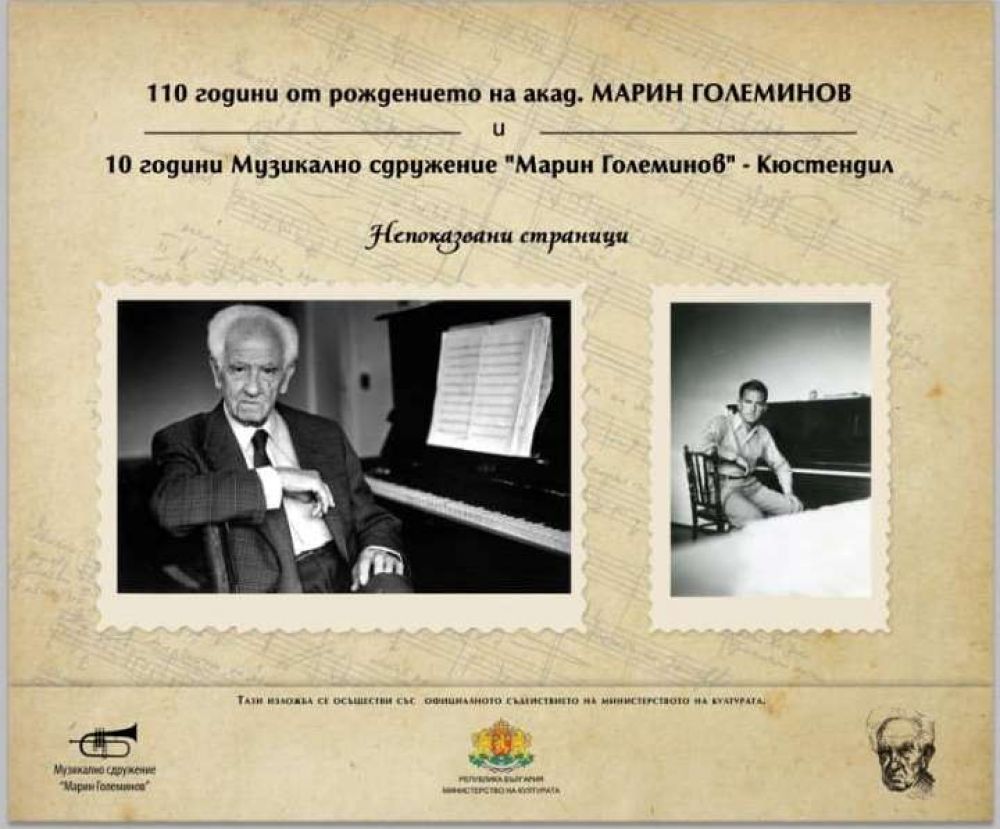
Exhibition "Frescoes and Sounds" - unseen pages from the life of Marin GOLEMINMOV in the Stara Zagora Opera House
On 18 December, Tuesday, at 18.00 in the foyer of the building of the State Opera Stara Zagora will be officially opened an exhibition dedicated to the 110th anniversary of the birth of the great Bulgarian composer Marin Goleminov. The opening will be attended by the composer's granddaughter Lilia Goleminova, who is the author of the exhibition, initiated by Goleminov's heirs. The exposition is realized with the support of the Ministry of Culture. The great Maestro Marin Goleminov is an honorary citizen of Stara Zagora, a long-time chairman of the unique Festival of Opera and Ballet Art-Stara Zagora. It is no coincidence that after the presentation in Sofia - in the gallery of the Ministry, as well as in the hometown of Marin Goleminov - Kyustendil, the exhibition "Frescoes and Sounds" comes to Stara Zagora.
From 18 December 2018 to the end of January 2019, viewers will be able to see 23 panels of significant moments from Goleminov's life - photographs, manuscripts, letters, diplomas. Unseen photographs from the composer's youth, including a series with his cousin, the architect Delcho Sugarev - both keen mountaineers - are also featured. There are also photographs from Goleminov's wedding to Lilia Nichkova, correspondence with Dimitar Nenov, Konstantin Iliev and other great musicians. Letters from his teachers in Paris and Munich, as well as Goleminov's diploma with which he graduated with full honours from the Academy of Music are among the other highlights. Programs from the Nestinarka dance drama's travels around the world, from landmark concerts of quartets performing Goleminov's music, from tours of the first winners of the Acad. Photos from the premiere of Zachary Zograf with Nikola Guzelev and impressive shots from the performance of the opera Ivaylo on Tsarevets complete the picture. Special attention is paid to the interpretation of the music of the eminent Bulgarian composer in the landmark year 2018 - with the re-staging of "Nestinarka" in Stara Zagora, with the double bass concerto, which was performed in Bulgaria and Mexico in one day... Special attention is also paid to Marin Goleminov as a conductor (little known is the fact that it was he who is considered the founder of the Faculty of Orchestral Conducting with the first conducting course, which he organised in 1943) with intriguing posters from a concert at Radio Sofia, where under his baton Dimitar Nenov played three of the great piano concertos in one evening.
The materials presented are from the personal archives of Marin Goleminov's grandchildren, Lilia and Stefan, and some of the photographs were provided by the Sugarevi family.
MARIN GOLEMINOV was born in Kyustendil on 28 September 2008 in the family of the lawyer Petar Goleminov and Raina Grebenarova. Soon the family moved to Gorna Dzhumaya (today's Blagoevgrad). Goleminov graduated from the Sofia Conservatory (as a violinist under Todor Torchanov) and went to study in Paris. His name is in the gallery of the most distinguished students of Scola Cantorum in the French capital, where he studied composition with Vincent D'Endy, Paul Le Flemme and Guy de Lioncourt. At the same time, he attended lectures on philosophy and aesthetics at the Sorbonne. Later he specialized in Munich, where his idea of writing a dance drama crystallized. Goleminov returned to Bulgaria and taught at the First Male Gymnasium. In 1942 he premiered "Nestinarka" (based on the story by Konstantin Petkanov) on the stage of the Sofia Opera. It caused a real furore and overnight Goleminov became famous. His opera "Ivaylo" was the first to be staged on Tsarevets Hill in Veliko Tarnovo. It started the tradition of presenting operas there. Then - in 1985 - the performances of "Ivaylo" were attended by more than 14 000 spectators. Goleminov's quartets are among the best examples of this genre in Bulgaria. Two of them - "Old Bulgarian" and "Microquartet" are performed very often today, not only in our country, but also in Europe and the USA. In 1963, a new version of the "Bolshoi" was published. Marin Goleminov wrote his unique "Concerto for String Quartet and String Orchestra", which opened a new page in his oeuvre - modern, with laconic expression, still with the best of European musical aesthetics, but now with typical Goleminovian expression. Dedicated to the Dimov Quartet, this work continues to be performed continuously, even in 2008 the renowned Vienna Steede Quartet presented Goleminov's work in Sofia. His other works, a staple of Bulgarian classical music, include Symphonic Variations on a Theme by Dobri Hristov (which premiered in Frankfurt and was such a stunning success that the performers "had to" come out to bow more than 10 times; Five Sketches for String Orchestra, Small Suite for Solo Violin, and Three Songs after Pictures by the Master. Among Goleminov's musical and stage works are the operas Zachary the Zographer (at the premiere Nikola Gyuzelev sings and paints on stage) and Thracian Idols, and the ballet Kaloyan's Daughter. Marin Goleminov is among the best orchestrators in the history of Bulgarian music. In addition to being a composer, Goleminov was also a critic, conductor and professor at the Academy of Music. Among his pupils are Georgi Minchev, Plamen Djurov, Emil Tabakov, Stefan Dragostinov, Dimitar Hristov and others. Sam says that he has always loved writing both notes and words. Among the works he has published is Behind the Scenes of the Creative Process, a unique publication in Bulgarian and French that explores the process of creation and interpretation in a truly innovative way. His dance drama, Nestinarka, is the most-performed out-of-country Bulgarian music-stage work. "The Nestinar Choro is an emblematic work of Bulgarian music that continues to be performed continuously both at home and abroad. With it, Bulgaria "took over" the European Presidency on the first day of 2018. "Nestinarka" has been staged in the Czech Republic, Germany and Russia. It has been performed by the Sofia Opera Ballet in Barcelona, Venice, Frankfurt, and in the version that Margarita Arnaudova created for the Arabesque Ballet, it has been performed in over 50 countries. In 2018, "Nestinarka" came to life in its full version, created in 1986 for the National Ballet, and on the stage of the Stara Zagora Opera in a performance by the theatre's multinational ballet company. The prima ballerina Anelia Dimitrova received for the role of Demna the prestigious award of SBMTD and Radio Classic FM "Crystal Lyra" - in the category "Young Performer".
A broad-minded, encyclopaedic personality, a true European, Marin Goleminov said long before our country entered the EU that our culture has long been in Europe. Unlike many other composers of his generation, the artist always supports young composers, avant-garde ideas, innovative thinking. He is known for his particular sense of humour, his ability to appreciate and sum up any situation in just a few, extremely well-chosen words. His student Stefan Dragovstinov is adamant that his name says it all - BIG and NEW. Marin Goleminov died on February 19, 2000, having lived to see the new millennium. Having lived 91 years, he witnessed all the memorable and turning events of the twentieth century. One of his last works is called "Resurrection for the Living".
In 2016 in Kyustendil was established the National Award for a bright presence in music in the name of acad. Marin Goleminov. Its first winners were the chamber ensemble "Sofia Soloists" with conductor Plamen Djurov (a composition of which Goleminov was also a conductor), prof. Pavel Gerdzhikov, and this year it was awarded to Arabesque Ballet.
From Goleminov's diary - "Three months after the premiere in Sofia in 1942 the Sofia Opera had to attend a visit to the opera in Frankfurt am Main. "Nestinarka" was included in the programme. In Frankfurt a very nice critical review came out in the magazine founded by Schumann. Perhaps the saints Constantine and Helena were hovering over the birth cradle of the work! And so, with their blessing, to this day "Nestinarka" burns on the embers to rise like a phoenix from the ashes