"The Barber of Seville" on October 6
News публикувана на: 02.10.2017
 Go back
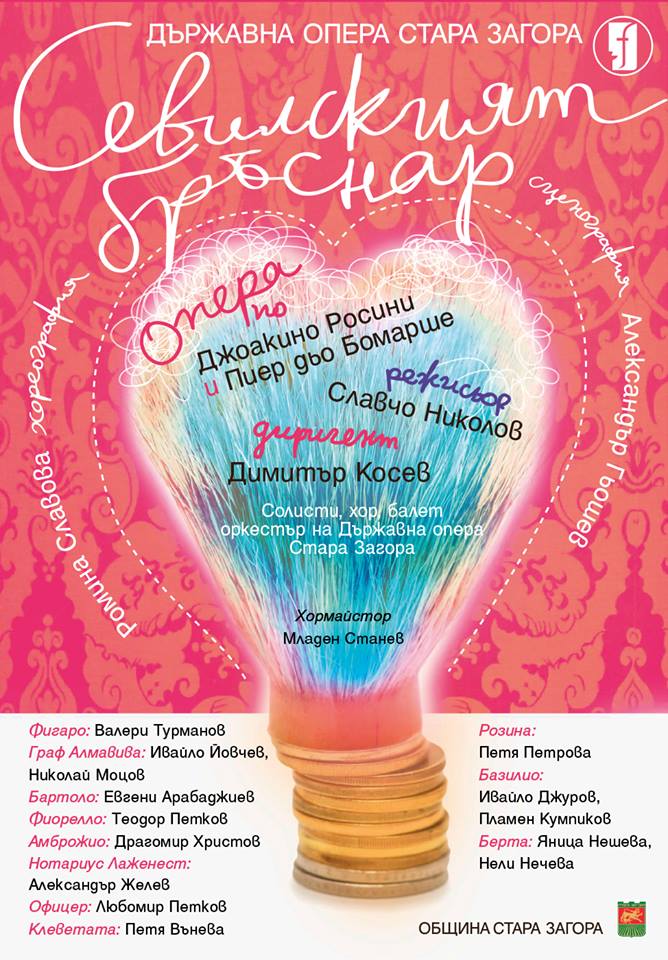
On 6 October at 7 pm, come to the pre-season premiere at the State Opera Stara Zagora - "The Barber of Seville" by Gioachino Rossini. Director Slavcho Nikolov stages the opera in its original Italian version together with the young and talented conductor Dimitar Kosev and choreographer Romina Slavova. The set designer is Alexander Goshev.
In the role of Figaro you will have the exclusive pleasure to see the young and extremely talented soloist of the State Opera-Stara Zagora Valeri Turmanov. The entire cast of the production is stellar - Count Almaviva is Nikolai Motov, Rosina is Petya Petrova, Doctor Bartolo is Evgeny Arabadzhiev, Don Basilio - Plamen Kumpikov, Berta - Yanitsa Nesheva, Fiorello is Theodore Petkov, Ambrogio - Dragomir Hristov, Notary, Lazeneste - Alexander Zhelev, Officer - Lyubomir Petkov, Slander - Petya Veneva, orchestra, choir and ballet of Stara Zagora State Opera.
"Rossini's The Barber of Seville and Verdi's La Traviata are the most favourite productions of the Stara Zagora audience. For the 90 years since the Opera House was established in our city, they have been the most frequently performed on stage and. The opera "The Barber of Seville" by Giacchino Rossini was staged in the City of Lime Trees for the first time on 4 December 1927. Subsequent premieres took place on 3 January 1945, 19 November 1957, 29 April 1972, 18 September 1980, 20 May 1991, 9 October 1998.
The opera was first called Almaviva, or Vain Caution, since an opera with the title The Barber of Seville had already been written by Giovanni Paisiello, the author of more than 100 operas. Rossini had respect and did not wish to cause the elderly composer any bitterness. The librettist Cesare Sterbini significantly revised Beaumarchais' comedy. It loses much of its satirical and expository force. For example, Count Almaviva is transformed from a typical member of the aristocracy into a sympathetic young man in love. But Sterbini, as a good connoisseur of the stage, makes a successful libretto for a comic opera.
In 1816, the 24-year-old Gioachino Rossini wrote and staged his opera in record time, presenting him as a gifted opera dramatist, a worthy follower of Mozart and of the finest operatic traditions of Italian opera-buffa.
"The Barber of Seville is a truly realistic musical comedy. The stage fate of this opera is curious. At the premiere held in Rome on 20 February 1816 it failed. This failure was also due to the supporters of Paisiello, who created a ruckus and confusion in the hall to prevent the audience from perceiving the new opera in peace. But by the third performance, The Barber of Seville was among those musical works that never grow old. At the time, one of the newspapers in Rome wrote: "If at the premiere The Barber of Seville did not meet with the approval of the audience, the second time and at subsequent performances it was appreciated on its merits and aroused such enthusiasm that the whole theatre trembled with exclamations of "E viva!" addressed to Maestro Rossini. Repeatedly summoned to the stage after the performance, he was finally taken home by the light of hundreds of torches."
◊ MORE ABOUT THE PERFORMANCE
It's a complicated and convoluted story when you want to win a girl's love and the whole world is against you. Figaro comes to Count Almaviva's aid to win the heart of his beloved Rosina. He's an unrivalled specialist in public relations, marketing and advertising! He's more - a wedding planner, matchmaker, psychotherapist from Seville, Spain. Figaro can give advice on writing love letters, acting, etc., he is a writer, actor and director of class - both in the performances of his life and the lives of others. Figaro knows how to make complex but strong connections - of the rich with the poor, of the lovers with the hard-hearted, of the innocent with the schemers. Figaro derives personal benefit for himself, but everyone also gets what they want - in the opera The Barber of Seville, based on the play by Pierre de Beaumarchais and music by Gioachino Rossini.
This production builds artistically on the previous one of the same name, staged on the very stage of the opera and intended for children from 7 to 15 years. It was created with the support of the Municipality of Stara Zagora and premiered on 17 April 2013. The young spectators, involved in various numbers and together with the singer-actors themselves, on stage experienced in these performances the miracle called "opera".