Go back

Ballet to music by Gioachino Rossini / Ottorino Respighi
Choreography by Alba Buonandi /Italy/
Scenography and costumes by Salvatore Russo /Italy/
Ballet of the State Opera - Stara Zagora
Children's and Youth Opera and Ballet Studio "Daisies" at the State Opera - Stara Zagora
Owner of the boutique /magician/ - Alexander Zhelev
Seller-consultant - Tomoki Ishigo
Pair of puppets, dancers of Kan-Kan - Romina Slavova, Fiordi Loha
Spanish doll - Anelia Dimitrova
Dendy - Francesco Boriello
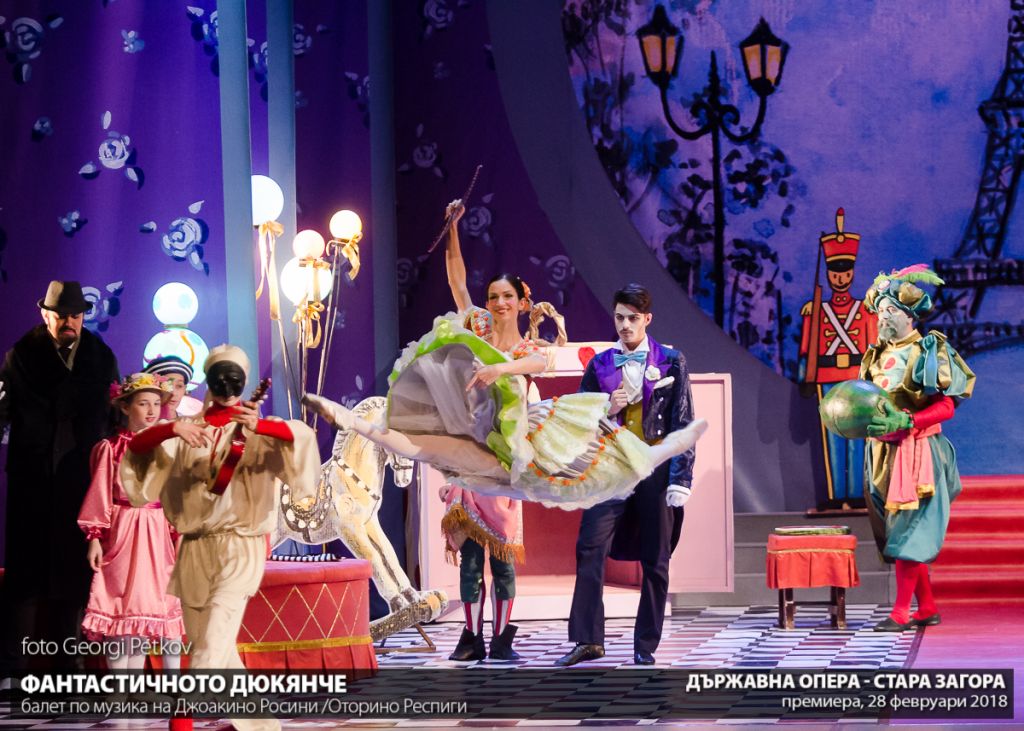
Pulcinella - Petya Veneva
Tarantella - Mariela Colaro
4 dolls - Chloe Alexander, Ivelina Dimitrova, Carmen Demirtash, Petya Veneva
Mazurka: Queen of the Cup - Juliana Koeva
Queen Caro - Radost Mladenova-Arabadjieva
King Spatia - Ivelin Khristakiev
King Spades - Stefan Donchev
Joker - Haruka Suga
Watermelon Seller - Dragomir Hristov
Poodles - Cloi Alexander, Riho Hirano
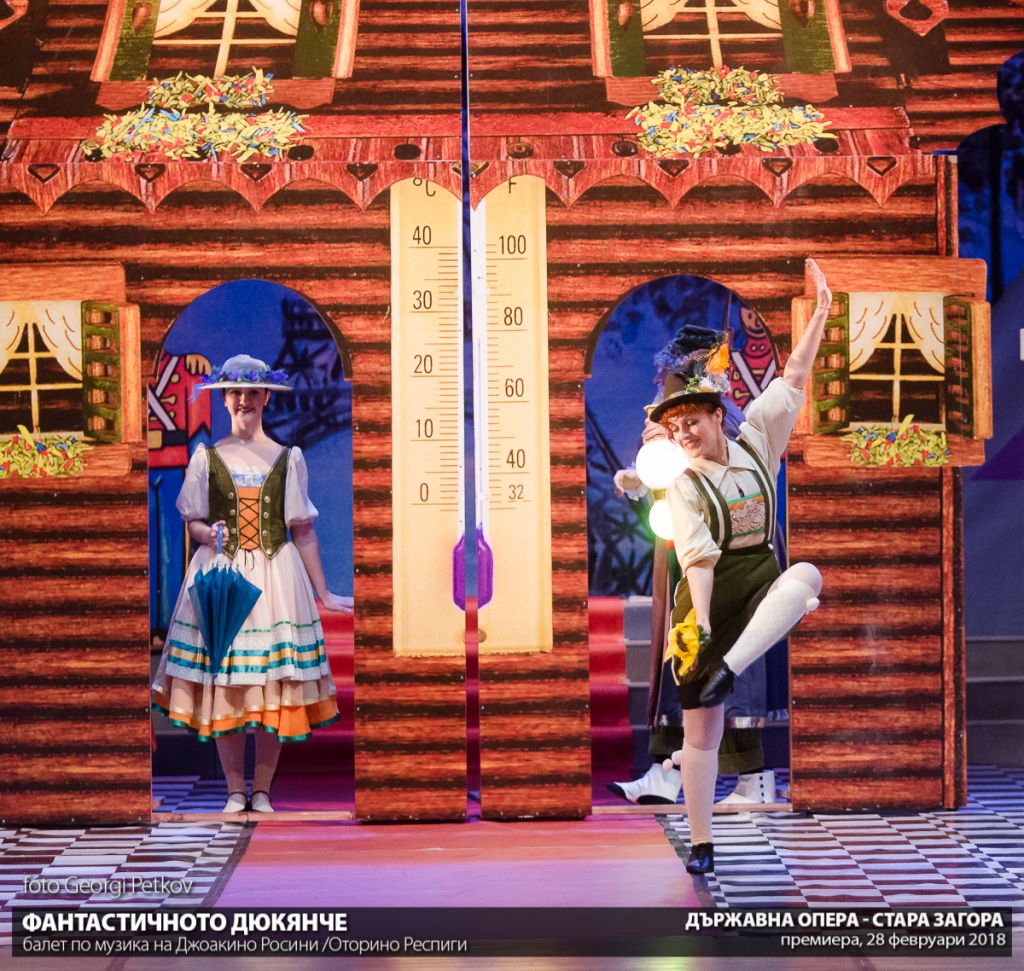
Tyrolean Dolls - Semela Schkenderasi, Laura Georgieva
Governess - Biljana Cholakova
Cossacks - Stanko Tanev, Ivaylo Yanev, Salvatore Laudani
Kan-Kan Dolls - Rio Suzuki, Penka Dimitrova, Nanako Imai, Carmen Demirtash
Thief - Ivan Kyuchukov
Carriers - Encho Neykov, Alexander Ivanov
Russian Family - Ivona Ivanova, Kamelia Stoycheva Hristo Ivanov, Mehmet Burkhanie
Children - DYSSOB "Margaritki"
American family - Nelly Necheva, Polina Ruseva, Nikola Marulev, Ivan Kolev
English Old Lady and Young Lady - Svetozara Koynarska, Margarita Tasheva
It is not the first time that the artist Salvatore Russo and the prima ballerina and choreographer Alba Buonandi have worked together - the biographies of the distinguished artists read more than 10 joint original ballet productions. In The Fantastic Boutique, the two unanimously decided, following the original libretto by Messina and Respighi, to enrich the story and tell it further. Myasin's libretto concentrates on the love story between two dolls dancing kan-kan in a toy shop. Salvatore Russo and Alba Buonandi enhance the role of the Magician who transforms the dolls into living people - he gives them hearts, helps the separated dolls to reunite and the story has its happy ending. Pulcinella, the Spanish doll, the nanny, appears in their show, and Rossini's music is added. Rousseau and Buonandi shift the action from mid-nineteenth century Paris to 1919, when the work premiered. The costumes bear the imprint of the fashions of those years in the clothing of the people who appear in the shop to buy dolls. Among the dolls, however, one can recognize the typical characters from silent films with the iconic figure of Charlie Chaplin's character with the bomb and cane.
Runtime: 1 hour without intermission
Premiere: 28.2.2018