Vladimir Boshnakov at 50: 'The modern conductor is a detective in terms of deciphering what is encoded in the score'
News публикувана на: 15.11.2021
 Go back
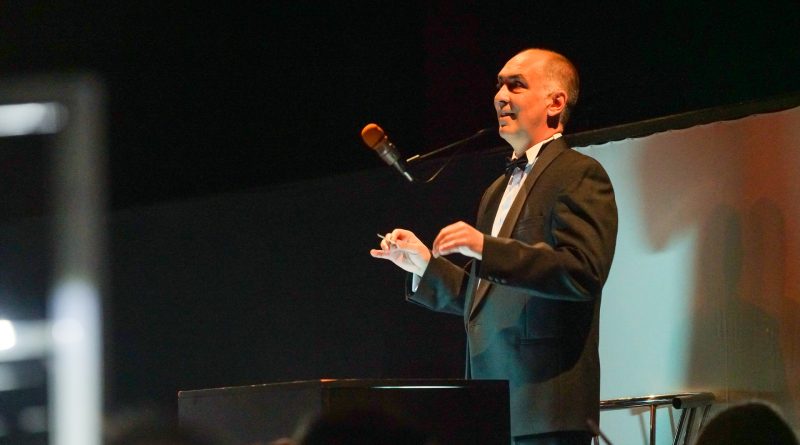
On the eve of its 50th anniversary we meet conductor Vladimir Boshnakov. His birthday was on 13 November 2021. Live and be well, Maestro!
Maestro Boshnakov's profession is as serious and precise as himself. The orchestra, respected by his approach, always sounds exemplary. He is also known as a fine psychologist when it comes to the bonding of musicians in a large collective, such as the symphony or opera orchestra. He and his beautiful wife, the opera prima Rusalina Mochukova, have a lovely family and two sons.
We would like to offer our readers, instead of a heated greeting on the occasion of the Happy Birthday, a curious interview that will show you the man, the musician, the conductor Vladimir Boshnakov in a slightly stronger light.
Who turned you on to music?
I am a third generation musician. My grandfather played first in the Tsar's orchestra, then in the military orchestra, and he was involved in the creation of the Pleven Philharmonic. He was a multifunctional musician - he played the clarinet, then when the Pleven orchestra was founded, due to the lack of bassoonists, he started playing the bassoon. At the same time my father went to study bassoon in Sofia, because there was no music school in Pleven yet. While still a student he played in the Sofia Philharmonic Orchestra, after which he returned to Pleven and continued to work in the Pleven Opera and the Pleven Philharmonic Orchestra. My musical and creative path began there.
At the age of 6 I started playing the cello at the Pleven Music School, and then I met my charismatic clarinet teacher. He ignited the spark for music in me and directed me towards conducting. His words were, "I think a musician can best express himself when he works with many other musicians and convinces them of his intentions for the music. You have to be involved in conducting." And indeed in Grade 10 of the School of Music I turned to conducting. I started playing piano very actively to prepare for the entrance exams and applied to the Conservatoire with a clarinet and theory major, where to my delight I was accepted into both majors, which I completed concurrently.
And how did your path as a conductor begin?
After the Conservatory I returned to Pleven, where I started working as an orchestrator in the Pleven Philharmonic Orchestra and a teacher at the Pleven Music School. After a year I decided that this was not enough and I should specialize in orchestral conducting. I discussed with the then management of the Pleven Philharmonic to continue as a conductor there. That's how my journey as a conductor began, at the age of 27. My graduation concert was with the Pleven Philharmonic with a soloist, my clarinet teacher, prof. Petko Radev. He was on the committee, as well as Acad. Vasil Kazandjiev. Then fate sent me to the Musical and Dramatic Theatre in Veliko Tarnovo, where I became chief conductor. Then I received an invitation from Maestro Naiden Todorov and continued as conductor at the State Opera-Ruse. It was in Ruse that I met the director Ognyan Draganov, who, now as director of the State Opera-Stara Zagora, invited me to work with him and I am currently working here. Otherwise, over the years I have been a guest in almost all the operas and philharmonic orchestras in the country.
What are the most valuable tips from your professors at the Conservatory, among whom is Acad. Vasil Kazandjiev?
He gave particularly valuable advice on working with the score and also on manual technique. He did not give any guidelines as to how the conductor should behave with the orchestra and the performers. Each conductor finds his own way with the orchestrators and soloists. Some impose it through persuasion and diplomacy, others through terror... Acad. Vasil Kazandjiev is an extremely persuasive and diplomatic man. I have received particularly valuable advice on interpretation from prof. Petko Radev. He was principal clarinettist and soloist of the Scala di Milano orchestra for 12 years. He has worked with conductors such as Carlos Kleiber, Claudio Abado and Karajan. From his stories, my desire for conducting became even greater. He knew I was studying conducting and spoke to me a lot about how they worked with the orchestra.
What are the first experiences of a 25-year-old young man as a conductor?
I remember it very well, it's one of the strongest emotions I've had. Once you leave the classroom, where you have lessons with just the professor and the piano, and you're in front of 50 musicians with years of experience, your pulse goes over 120, your heart is in your throat, your brain is "fuming," and your hands are cold. Over the years, these feelings are harnessed, everything falls into place, becomes a positive emotion and becomes the energy of the musical experience.
Does an orchestra have a face, does it feel like a whole or do you feel individual musicians giving the orchestra a face?
I think I'm a pretty good psychologist. When I start working with an orchestra I feel the alpha musicians. Once you get a feel for them and you start to influence them, then the orchestra takes on the physiognomy, figuratively speaking, and the sound that you want to give it. When you can breathe your energy into them, you should be able to shape the orchestra, and that's the point of our profession.
And where does your interest come from in working with different actors and pop artists with whom you do concerts combining classical and contemporary?
I've always tried over the years to have another mission besides interpretation - to make classical music accessible to a wider audience. That was the idea of the project with Ruslan Muynov, a very famous TV face, an artist with incredible vocal data. His charm and charisma attract a wider audience to classical music. People come to these concerts and I hope that afterwards they will visit the operas from which Ruslan performs. I have also wanted very much over the years to educate the young audience - the children. With the Pleven Orchestra I have had over 200 educational concerts since the beginning. We have done a huge number of thematic concerts with famous opera and operetta artists. I have also staged many children's musicals, both in Pleven and in Tarnovo, and then in Ruse. I am very keen that the next generations that come are educated musicians and prepared audiences.
What was your experience with the Studio Primo chamber orchestra?
That was another challenge. The idea there was to bring together top musicians from all the orchestras in Bulgaria in one ensemble. With this orchestra we did a lot of projects with famous soloists - Vasko Vassilev, Svetlin Rusev, Yildiz Ibrahimova, Teodosii Spasov. My experience with these musicians enriched me a lot, from 2002 to 2010 we performed actively.
Could it be said that the conductor is also a kind of musical detective, searching for and finding unknown, unfamiliar music?
I think it is the priority of conductors and interpreters who deal with early music. The modern conductor is more of a detective in terms of deciphering what is encoded in the score - the encoded music, the encoded messages. I know from experience that a symphony performed by Carlos Klaiber can end 15 minutes faster than the same symphony conducted by Sergiu Celibidache, and each of these performances will have its own beauty and meaning.
Last time in Stara Zagora you were the conductor of two ballet productions, Sleeping Beauty and Pilate's Dream. Do you like being a conductor of a ballet performance?
Ballet is a beautiful, elite art and it is a challenge for a conductor to conduct it. On the other hand, ballet music is extremely beautiful symphonic music, sound-imagery that complements what is happening on stage. And last but not least, once the ballet has been staged, every other time you conduct it you are required to be as concentrated as possible to present the music in the same way it was in rehearsal and at the previous performances. You are not allowed to have a different emotion, you have to have a cool brain and a warm heart.
Are you happy with your students at the Academy, are there talents among them?
I have a lot of "colorful" students, some I see in the future on stage and some are just in the Academy and will graduate, finishing with music. Such are the times. It's important to take what's valuable off the table and support it, give it wings, because it's our future, our future as musicians, and mine as a conductor.
I hear that you are writing an interesting dissertation and that you are working on it in Vienna as well....
The topic is about the relationship between Puccini and Lehar - friendly and creative, coded in their scores. I have the pleasure of knowing in Vienna the woman who looked after Lehar's brother, who lived in the villa bought by the composer in Vienna. The lady has given me access to a large part of the Lehar archive, which is not in the domain of museums but is still in that villa. Puccini was a guest there. I saw his messages written on photographs and postcards about Lehar and many other interesting things. I think it was this experience of mine with operetta and opera that led me to bring out the commonalities between these composers.
Is a fourth generation of Boshnak musicians emerging?
No one ever knows. For now, both our sons have an interest in music at an absolutely amateur level . I don't push them. I have lived my childhood years as a music student. My older son definitely takes every opportunity to play flute and piano. A few more years and he will choose what to do.
It seems to me that you are satisfied with the past 50 years of life?
Yes, I am satisfied. I think that the place where I am now - Stara Zagora and the State Opera-Stara Zagora, also the State Opera-Ruse, the Municipality of Veliko Tarnovo with the Festival "Stage of the Ages", of which I am the artistic director, and teaching at the Music Academy in Sofia, for these 50 years are what I have aspired to. God grant that 50 years may be the middle of a conscious creative life.
Conversation by Uliana Kyoseva